VN
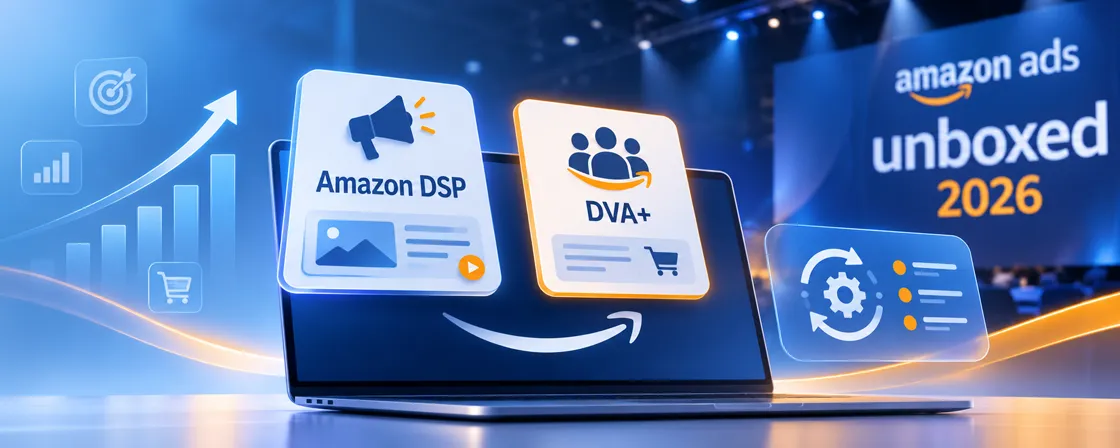

Following Amazon UnBoxed 2026, Amazon Ads has officially restructured its advertising ecosystem, phasing out the standalone “Amazon DSP” branding and integrating its capabilities into the unified Amazon Ads Agent interface through DVA+ campaigns.
However, many sellers in Vietnam still have a limited understanding of DSP and the latest changes to Amazon Ads. Join Innovark Solutions as we explore what DSP really is and discover the new and enhanced capabilities it brings following Amazon’s latest transformation.
1. What Is Amazon DSP? How Is It Different from PPC?
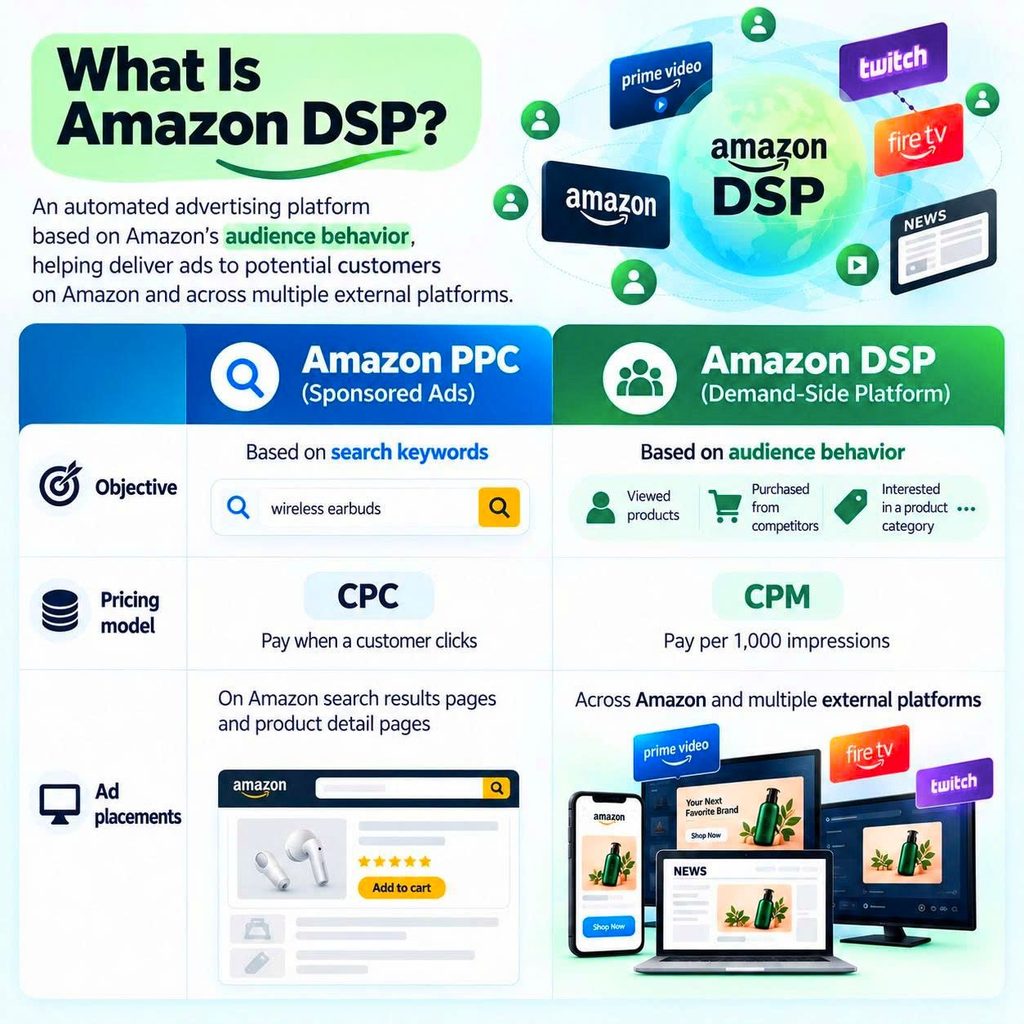
To put it simply, Amazon DSP (Demand-Side Platform) is a programmatic advertising platform that enables advertisers to automatically purchase ad placements based on audience behavior (Audience-based) rather than search keywords (Query-focused), as with PPC.
DSP leverages Amazon’s massive pool of first-party user data — including product browsing history, shopping behavior, geographic location, and entertainment preferences — to proactively place advertisements (in the form of display banners, videos, or audio ads) in front of potential customers, whether they are on Amazon or browsing the web and watching content outside Amazon (Prime Video, Fire TV, Twitch, and thousands of partner websites).
DSP can be considered an upgraded form of Sponsored Display advertising, offering more advanced targeting capabilities.
How Does DSP Differ from PPC?
| Criteria | PPC Advertising (Sponsored Ads) | DSP Advertising (Demand-Side Platform) |
| Targeting Mechanism | Keyword / Search Intent-based: Ads appear when customers search for specific keywords. | Audience Behavior-based: Targets users who have viewed product listings, purchased competing products, or shown interest in a particular product category. |
| Pricing Model | CPC (Cost-Per-Click): Advertisers pay when customers click on their ads. | CPM (Cost-Per-Thousand Impressions): Advertisers pay for every 1,000 impressions. |
| Ad Placements | Primarily on Amazon search results pages and product detail pages. | Omnichannel: Across both Amazon and external news websites, apps, and Smart TVs. |
2. The Latest Changes to Amazon Ads: Why Is Amazon DSP No Longer a Standalone Name?
The recent Amazon UnBoxed 2026 event marked one of the biggest turning points for Amazon Ads in recent years. Amazon has reoriented its entire advertising ecosystem towards unification (Unified) and an AI-first approach. As a result, DSP has officially been integrated with other Amazon advertising formats into a unified management system called Amazon Ads Agent.
Previously, Amazon’s advertising system was divided into two separate platforms:
- Ads Console (Traditional PPC Channel): Where sellers independently set up Sponsored Products and Sponsored Brands campaigns.
- Amazon DSP Console (Programmatic Advertising Platform): A completely separate and complex interface requiring advanced technical expertise, dedicated data, and stricter approval processes.
To make it easier for sellers to manage and control budgets across multiple Amazon advertising formats, Amazon Ads Agent was introduced:
- Unified Data & Platform: Bringing together search advertising (PPC) and all display, video, and audio advertising formats (including Sponsored Display, Sponsored TV, and legacy DSP) into a single campaign format called DVA+.
- AI-Powered Simplification: With an integrated AI assistant (Conversational AI), sellers can request reports, analyze performance, or optimize campaigns using natural-language prompts in Vietnamese or English instead of navigating complex manual processes.
- Omnichannel Pacing Optimization: AI automatically tracks customer behavior throughout the journey, from watching videos on Prime Video to searching for keywords on Amazon, to allocate advertising budgets more intelligently.
For simplicity, we can refer to these display advertising formats (formerly associated with DSP) as DVA (Display, Video, Audio).
3. Common Misconceptions About Using DVA
When sellers first start exploring DVA (DSP), they often encounter three major misconceptions:
Misconception 1: “You Need to Spend Tens of Thousands of Dollars on Custom Images and Videos Before You Can Run DVA Campaigns.”
– The Reality: One of the most effective formats with the most natural conversion rates on DVA is Responsive E-commerce. Amazon automatically pulls images, titles, prices, and ratings directly from your listing to create native-standard banner ads. These ads feel more familiar to shoppers, making them more likely to click and purchase than overly elaborate promotional banners.
Misconception 2: “DVA Must Generate Direct Sales Immediately, Just Like PPC.”
– The Reality: DVA plays a role in influencing customer perceptions and retargeting potential buyers. A customer might see a DVA video while relaxing on the sofa and watching TV without clicking to purchase immediately. However, the following day, they may visit Amazon, search for your brand name, and make a purchase through PPC.
Measuring DVA performance requires looking at Total ACoS (TACoS) and New-to-Brand growth, rather than focusing solely on direct ROAS.
Misconception 3: “You Need an Extremely Large Budget (30,000–50,000/Month) to Access DVA.”
– The Reality of DSP Seats: If an independent seller wants to apply for their own DSP account directly from Amazon (Self-Service Seat) or use Amazon-managed services (Managed Service), Amazon typically requires a very strict minimum spending commitment (often starting at $50,000/month or more). This is a significant barrier for small and medium-sized businesses.
– The Optimal Solution: The most practical and flexible approach is to partner with agencies that already hold official DSP Seats (such as Innovark Solutions). By running campaigns through an agency’s Seat, sellers are not subject to Amazon’s substantial minimum spending requirements and can easily test DVA campaigns with flexible budgets starting from just a few thousand USD per month.
4. The Role of DVA in the Full-Funnel Sales Journey
To maximize the effectiveness of DVA, sellers need to position it strategically at the right stages of the customer journey.
Let’s explore how DVA can be applied to two key Vietnamese export industries: Groceries (Food & Beverages) and Apparel (Fashion).
[ Top of Funnel: Expand Reach & Discover New Potential Audiences ]
│
▼
[ Middle of Funnel: Competitor Conquesting & Retargeting ]
│
▼
[ Bottom of Funnel: Increase Customer Lifetime Value (LTV) ]
A. Top of Funnel: Expand Reach & Discover New Potential Audiences
DVA reaches people who have never heard of your brand but whose consumption habits are highly relevant to your products.
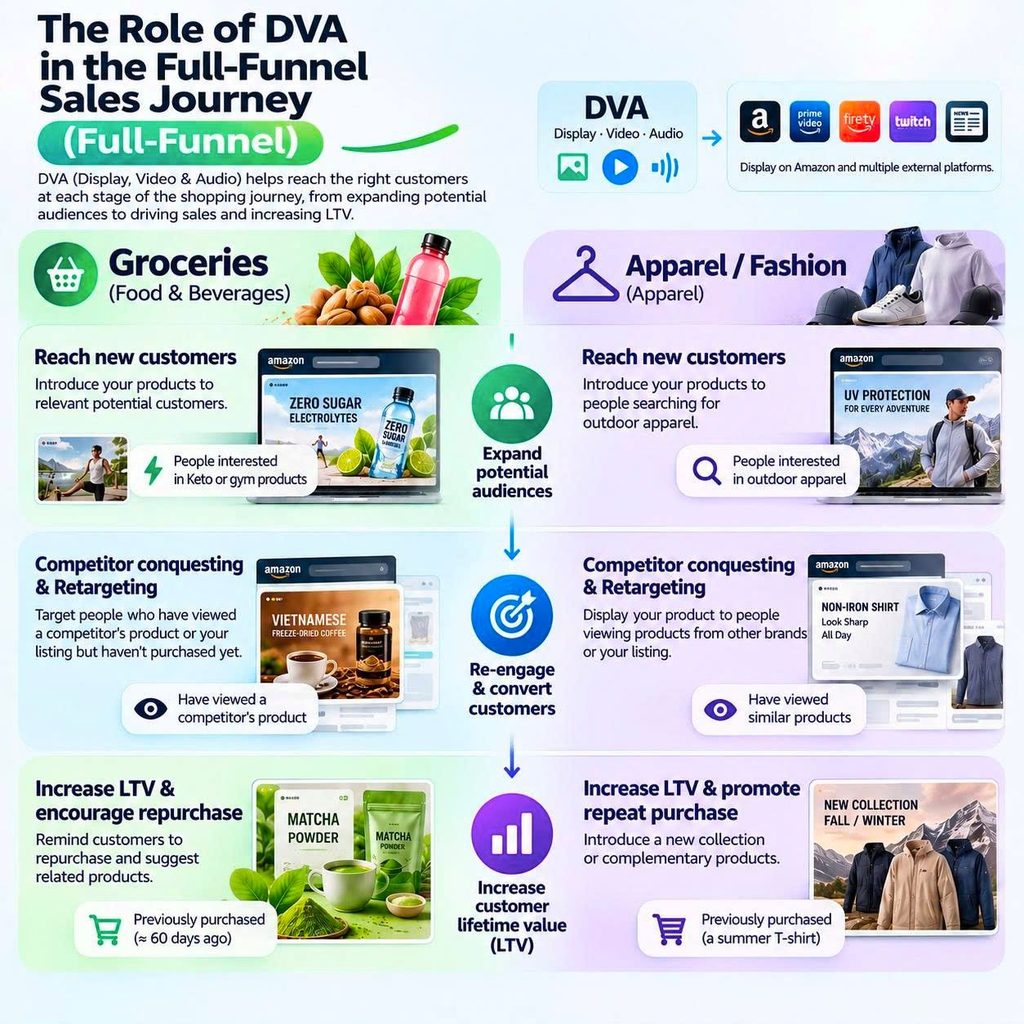
- Groceries: A customer has recently purchased Keto-friendly products or gym-related products. DVA displays banner ads promoting your Zero-Sugar Electrolytes or Organic Nuts & Seeds.
- Apparel: A customer has recently searched for outdoor sportswear. DVA introduces your UV-Protection T-shirts or lightweight Sports Windbreakers.
B. Middle of Funnel: Competitor Conquesting & Retargeting
- Competitor Conquesting:
- Groceries: Directly target shoppers who have viewed listings from major competing brands (e.g., premium instant tea or coffee brands) but have not made a purchase. DVA displays ads promoting your rich-tasting Vietnamese freeze-dried coffee at a more reasonable price.
- Apparel: Target shoppers who are browsing men’s dress shirts from major brands. DVA displays your Non-Iron Dress Shirts directly on competitors’ product detail pages.
- Retargeting: Target shoppers who have clicked on and viewed your listing within the past 30 days but have not made a purchase, excluding those who have already purchased. DVA ads reappear on external news websites to remind them to return and complete their purchase.
C. Bottom of Funnel: Increase Customer Lifetime Value (LTV & Loyalty)
Encourage existing customers to make repeat purchases or cross-sell other products from your store.
- Groceries: A customer purchased a box of your Cocoa/Matcha Powder 60 days ago. DVA automatically displays repurchase reminder ads at the right time, just as they are about to run out of the product.
- Apparel: A customer previously purchased a Basic Summer T-shirt. DVA launches a campaign introducing your newly released Autumn–Winter Jacket Collection to encourage them to continue supporting your brand.
5. Who SHOULD and SHOULD NOT Start Using DVA?
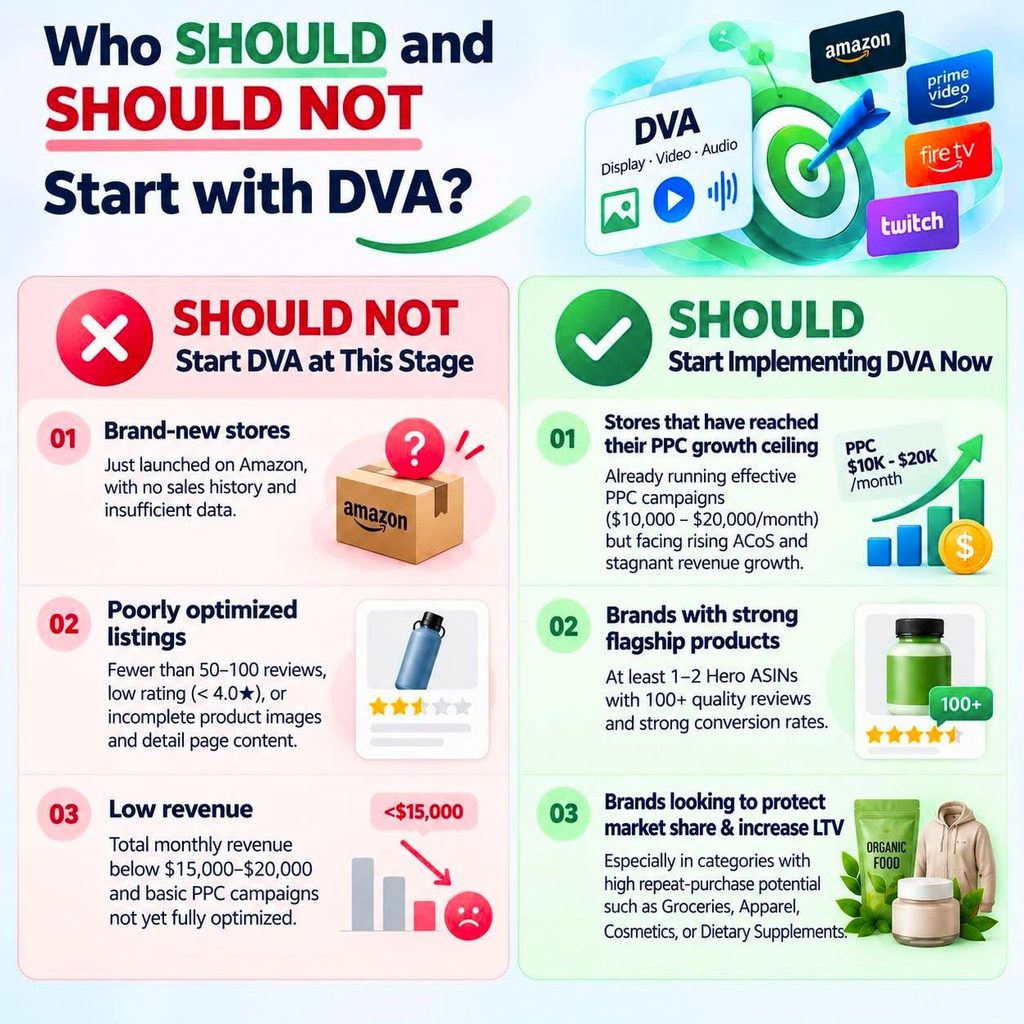
Who SHOULD NOT Run DVA at This Stage?
- Brand-new stores: Stores that have just launched on Amazon, with no sales history and insufficient accumulated data.
- Poorly optimized listings: Products with fewer than 50–100 reviews, low ratings (below 4.0 stars), or incomplete product images and detail page content. (DVA can drive a significant amount of traffic, but if your listing is poorly optimized, your conversion rate may still be zero.)
- Stores with low revenue: Stores generating less than 15,000–20,000 in total monthly revenue and have not yet fully optimized their basic PPC campaigns.
Who SHOULD Start Implementing DVA Now?
- Stores that have reached their PPC growth ceiling: Sellers who are already running effective PPC campaigns (with monthly PPC budgets of 10,000–20,000) but are facing increasingly expensive keyword bids, sharply rising ACoS, and stagnant revenue growth.
- Brands with strong flagship products: Sellers with at least 1–2 established Hero ASINs, each backed by 100+ quality reviews and strong organic conversion rates (CVR).
- Brands looking to protect market share and increase LTV: Particularly those operating in categories with high repeat-purchase potential, such as packaged food (Groceries), newly launched fashion collections (Apparel), cosmetics, and dietary supplements.
Conclusion & Choosing Innovark Solutions as Your Partner
Shifting from a search-based advertising mindset (PPC) to a full-funnel marketing strategy (Full-Funnel with DVA) is an essential step for any Vietnamese brand seeking sustainable growth on Amazon. Don’t let changing terminology or technical barriers hold you back.
At Innovark Solutions, we offer:
– Official DSP Seat Access: Enabling your business to launch DVA/DSP campaigns immediately with highly flexible testing budgets, without worrying about Amazon’s minimum spending requirements.
– An Experienced Team of Specialists: With in-depth knowledge of shopping behavior in the US/EU markets, and specialized expertise in building full-funnel advertising strategies for the Apparel and Groceries/food export industries.
– A Transparent Measurement Framework: Helping you monitor overall Total ACoS (TACoS) and optimize costs across every customer touchpoint.